



What Does Managed IT Include for Businesses?
If your team is still calling three different vendors to solve one infrastructure problem, the question is not whether you need support. It is what does managed IT include when the service is actually built to reduce risk, improve uptime, and give your business room to grow.
For most small and mid-sized businesses, managed IT is not just a help desk contract. A capable provider takes responsibility for the health, security, performance, and day-to-day operation of your technology environment. That can cover end-user support, cloud infrastructure, cybersecurity, patching, backups, compliance controls, vendor coordination, and strategic planning. The exact scope depends on your environment, but the point is consistent: managed IT should replace fragmentation with accountability.
What does managed IT include in practice?
At a practical level, managed IT includes the services required to keep systems operational and users productive without waiting for something to break first. That usually starts with monitoring and support, then expands into maintenance, security, and planning.
A provider will typically monitor servers, networks, endpoints, cloud resources, and business-critical applications for availability, performance, and signs of failure. Instead of reacting after downtime hits, they identify issues early, investigate alerts, and resolve problems before they affect users. That proactive model is one of the biggest differences between managed IT and traditional break-fix support.
User support is another core component. Employees still need password resets, device troubleshooting, application support, onboarding, and offboarding. A managed IT partner handles those routine tasks in a structured way, usually through a service desk with defined response times and escalation paths. For leadership, that means fewer interruptions. For internal IT teams, it means less time burned on tickets that distract from larger priorities.
Infrastructure maintenance is also part of the package. This includes operating system updates, patch management, hardware lifecycle planning, software version control, configuration reviews, and policy enforcement across endpoints and servers. If your environment spans on-prem systems, AWS workloads, SaaS apps, and remote users, that maintenance layer matters even more because inconsistency creates risk fast.
Core service areas most businesses should expect
The strongest managed IT offerings are modular, but there are several service categories that should be considered foundational.
Help desk and end-user support
This is the most visible layer. It covers day-to-day technical support for laptops, desktops, mobile devices, collaboration tools, email, VPN access, and common business applications. Good support is not just about answering tickets quickly. It should be documented, measurable, and tied to service levels that match business impact.
For example, a login issue for one user and an outage affecting your entire remote workforce should not sit in the same queue with the same urgency. Mature providers classify incidents, prioritize correctly, and communicate clearly.
Network and infrastructure management
Managed IT commonly includes oversight of firewalls, switches, wireless networks, virtual machines, storage, identity systems, and internet connectivity. In cloud-first environments, this also extends to AWS infrastructure, virtual private networks, access controls, compute resources, and architecture review.
The value here is not just administration. It is operational stability. Poorly managed infrastructure leads to recurring outages, inconsistent performance, and difficult troubleshooting because no one owns the full picture.
Monitoring, alerting, and observability
Monitoring tells you something is wrong. Observability helps explain why. A modern managed IT partner should provide both, especially if your business relies on customer-facing applications, hybrid environments, or distributed systems.
That can include infrastructure monitoring, log aggregation, application performance tracking, capacity thresholds, and incident response workflows. Tools matter, but the operating model matters more. If alerts are not tuned, triaged, and acted on, they are just noise.
Patch management and system updates
Unpatched systems are one of the easiest ways for attackers to gain a foothold. They are also a common source of performance issues and software instability. Managed IT should include regular patching for operating systems, third-party applications, firmware, and endpoint agents.
That said, good patching is never just automatic across everything. Production workloads, legacy applications, and regulated systems may require testing, maintenance windows, rollback planning, and change control. This is where experienced providers separate themselves from low-cost vendors.
Security is no longer optional scope
A serious answer to what does managed IT include has to include cybersecurity. Without it, the service is incomplete.
Most businesses need at least baseline protections such as endpoint detection, managed antivirus, email security, multifactor authentication, firewall management, vulnerability scanning, backup validation, and access control review. Many also need security awareness training, incident response support, and policy development.
For companies in regulated industries or handling sensitive customer data, the bar is higher. Security services may need to include log retention, SIEM integration, compliance reporting, privileged access controls, encryption policy enforcement, and documented recovery procedures. Security as a Service can sit alongside managed IT or be tightly integrated with it, depending on the provider model.
The trade-off is cost versus exposure. A smaller business may not need a full security operations capability on day one, but it does need layered controls and a provider that knows where the gaps are.
Backup, disaster recovery, and business continuity
Every managed IT agreement should address what happens when systems fail. Backups alone are not enough if restores are slow, incomplete, or untested.
Managed IT often includes backup scheduling, storage management, recovery point planning, disaster recovery design, and restore testing. In more mature engagements, it also includes continuity planning around cloud failover, redundant infrastructure, and documented recovery workflows for critical systems.
This matters for more than ransomware. Hardware failure, cloud misconfiguration, accidental deletion, and software deployment issues can all disrupt operations. If recovery expectations are not clearly defined, businesses often discover the gap when pressure is highest.
Cloud management is increasingly part of managed IT
For many businesses, managed IT now includes cloud operations. If your systems run partly or entirely in AWS, support should go beyond keeping instances online.
Cloud management can include account structure, cost optimization, IAM governance, patching, backup policy, infrastructure as code support, performance tuning, monitoring, and Well-Architected Reviews. It may also cover migration planning, hybrid connectivity, container support, CI/CD coordination, and environment standardization with tools such as Terraform and Ansible.
This is one reason many companies move away from generic MSPs. Traditional providers may handle desktops and Microsoft 365 well but struggle when cloud architecture, DevOps workflows, and application infrastructure become central to operations. Businesses with growth plans need a partner that understands both support and modernization.
Compliance and documentation often separate strong providers from weak ones
Managed IT should also create operational discipline. That means documentation, reporting, and governance.
A provider should maintain current records of assets, configurations, access permissions, backup status, support history, and critical dependencies. Without documentation, support becomes personality-based rather than process-based. That creates risk whenever staff changes or an urgent incident crosses teams.
Compliance support may also be included if your business needs to meet frameworks or customer requirements. Depending on your industry, that can involve audit preparation, control mapping, policy support, log review, access reporting, and evidence collection. Not every managed IT provider is strong here, so this is an area worth vetting closely.
What managed IT may not include by default
This is where many businesses get caught off guard. Managed IT does not always include strategic projects, after-hours work, compliance consulting, software development, cloud migration, or major architecture redesign unless those items are explicitly scoped.
For example, routine AWS administration might be included while a full migration from on-prem to cloud is treated as a separate project. Endpoint support may be included, while procurement, cabling, or office moves are billed separately. Security tooling may be managed, but incident response retainers or forensic investigations may not be.
That does not mean the provider is falling short. It means managed IT is a service model, not a single standard package. The right question is not whether every service is bundled. It is whether the scope aligns with your operational risk and business roadmap.
How to evaluate whether a managed IT offering is complete
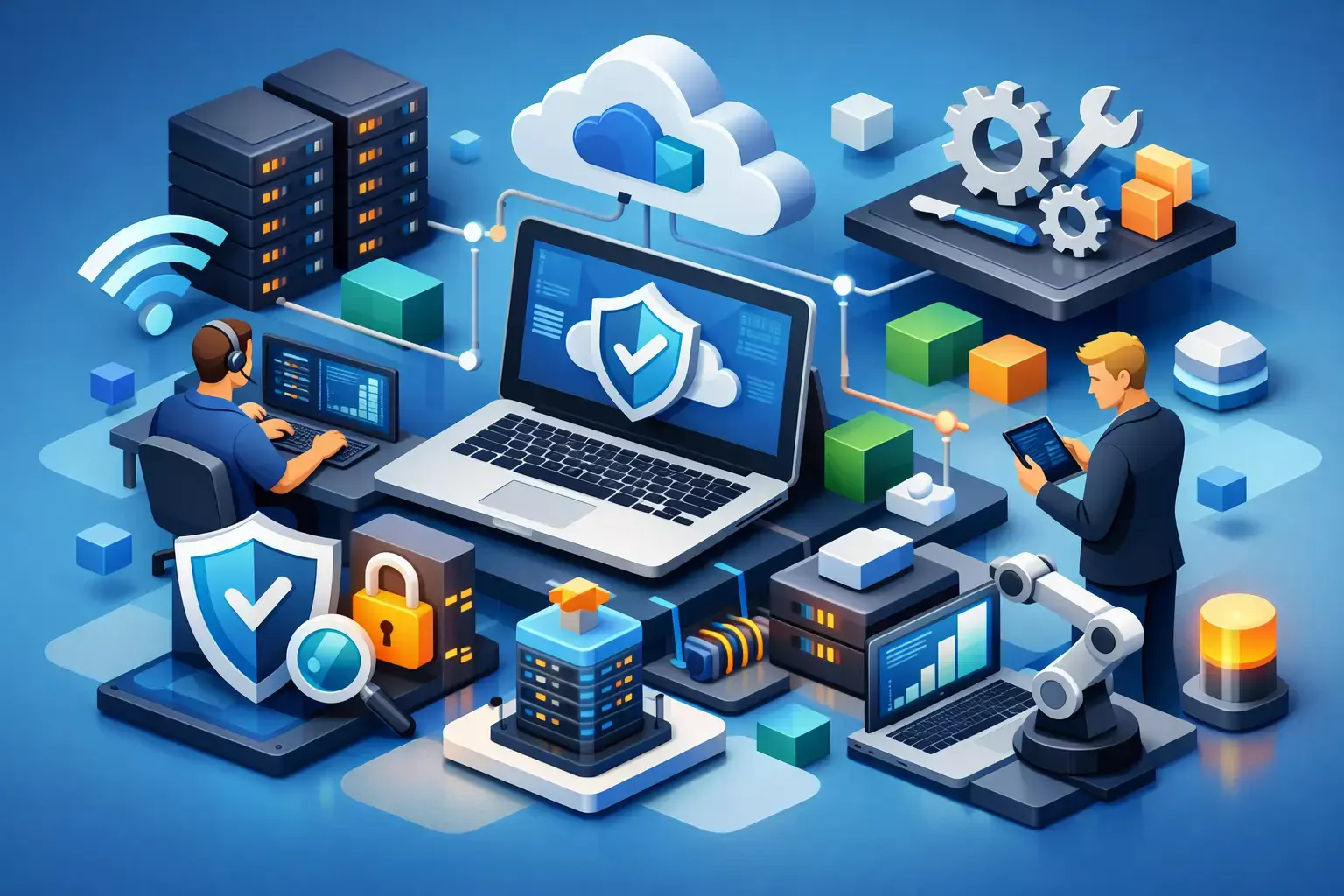
A complete managed IT service should show clear ownership across support, infrastructure, security, and planning. If you still need separate vendors for monitoring, backup, cloud issues, and cybersecurity, then the service may be too narrow for your environment.
Look for defined service levels, escalation paths, reporting cadence, tooling transparency, and clarity around what is proactive versus reactive. Ask how the provider handles patching exceptions, after-hours incidents, cloud cost drift, user onboarding, vendor coordination, and recovery testing. The answers will tell you whether you are buying real operational support or just outsourced ticket handling.
For growth-stage companies and digital-first businesses, the most effective model is often a single partner that can support the full lifecycle - infrastructure, cloud, security, observability, compliance, and ongoing improvement. That is where managed IT starts to deliver compounding value instead of just reducing short-term pain.
If you are asking what does managed IT include, you are really asking who is accountable for keeping your systems reliable, secure, and ready for what comes next. The best answer is not a list of tools. It is a support model built around ownership, depth, and the ability to grow with your business.
Frequently Asked Questions
1. What does managed IT include?
Managed IT typically includes help desk support, network and infrastructure management, system monitoring, patch management, cybersecurity, backup and disaster recovery, cloud administration, compliance support, and strategic IT planning. The goal is to provide ongoing oversight and accountability for your technology environment rather than simply fixing issues when they occur.
2. How is managed IT different from traditional break-fix support?
Traditional break-fix support responds after a problem has already caused disruption. Managed IT takes a proactive approach by continuously monitoring systems, identifying risks early, applying updates, and resolving issues before they impact users, helping improve uptime and reduce business risk.
3. Does managed IT include cybersecurity services?
Yes, most modern managed IT providers include core cybersecurity services such as endpoint protection, managed antivirus, email security, multifactor authentication, vulnerability scanning, firewall management, and backup validation. Some providers also offer advanced security services, compliance support, and incident response capabilities.
4. Is cloud management part of managed IT services?
In many cases, yes. Managed IT often covers cloud environments such as AWS, Microsoft 365, and SaaS applications. Services may include monitoring, access management, cost optimization, backups, performance tuning, infrastructure management, and support for cloud migrations or hybrid environments.
5. What services are not usually included in a managed IT agreement?
While coverage varies by provider, managed IT agreements do not always include major projects such as cloud migrations, software development, architecture redesigns, compliance consulting, after-hours work, or forensic security investigations. Businesses should review the service scope carefully to understand what is included and what may require separate project-based engagement.